For the third year in a row a I had the honor to present the first morning report of the academic year. Fluids, diuretics and dysnatremia:
Fluids And Electrolytes July1
View more presentations from Joel Topf.

musings of a salt whisperer
For the third year in a row a I had the honor to present the first morning report of the academic year. Fluids, diuretics and dysnatremia:
Its the first of July so that has me thinking about medical errors. In that vein here is an anecdote from Atul Gawande’s excellent Checklist Manifesto:
He told me about another patient, who was undergoing an operation to remove a cancer of his stomach when his heart suddenly stopped. John remembered looking up at the cardiac monitor and saying to the anesthesiologist, “Hey, is that asystole?” Asystole is total cessation of heart function. It looks like a flat line on the monitor, as if the monitor is not even hooked up to the patient.The anesthesiologist said, ‘A lead must have fallen off,” because it seemed impossible to believe that the patient’s heart had stopped. The man was in his late forties and had been perfectly healthy. The tumor was found almost by chance. He had gone to see his physician about something else, a cough perhaps, and mentioned he’d been having some heartburn, too. Well, not heartburn exactly. He felt like food sometimes got stuck in his esophagus and wouldn’t go down and that gave him heartburn. The doctor ordered an imaging test that required him to swallow a milky barium drink while standing in front of an X-ray machine. And there on the images it was: a fleshy mouse-size mass, near the top of the stomach, intermittently pressing up against the entrance like a stopper. It had been caught early. There were no signs of spread. The only known cure was surgery in this case a total gastrectomy, meaning removal of his entire stomach, a major four- hour undertaking.
The team members were halfway through the procedure. The cancer was out. There’d been no problems whatsoever. They were getting ready to reconstruct the patient’s digestive tract when the monitor went flat-line. It took them about five seconds to figure out that a lead had not fallen off. The anesthesi¬ologist could feel no pulse in the patient’s carotid artery His heart had stopped.
John tore the sterile drapes off the patient and started doing chest compressions, the patient’s intestines bulging in and out of his open abdomen with each push. A nurse called a Code Blue.
John paused here in telling the story and asked me to suppose I was in his situation. “So, now, what would you do?”
I tried to think it through. The asystole happened in the midst of major surgery. Therefore, massive blood loss would be at the top of my list. I would open fluids wide, I said, and look for bleeding.
That’s what the anesthesiologist said, too. But John had the patient’s abdomen completely open. There was no bleeding, and he told the anesthesiologist so.
“He couldn’t believe it,” John said. “He kept saying, “There must be massive bleeding! There must be massive bleeding!” But there was none.
Lack of oxygen was also a possibility. I said I’d put the oxygen at 100 percent and check the airway. I’d also draw blood and send it for stat laboratory tests to rule out unusual abnormalities.
John said they thought of that, too. The airway was fine. And as for the lab tests, they would take at least twenty minutes to get results, by which point it would be too late.Could it be a collapsed lung—a pneumothorax? There were no signs of it. They listened with a stethoscope and heard good air movement on both sides of the chest.
The cause therefore had to be a pulmonary embolism, I said—a blood clot must have traveled to the patient’s heart and plugged off his circulation. It’s rare, but patients with cancer undergoing major surgery are at risk, and if it happens there’s not much that can be done. One could give a bolus of epinephrine—adrenalin—to try to jump-start the heart, but it wouldn’t likely do much good.
John said that his team had come to the same conclusion. After fifteen minutes of pumping up and down on the patient’s chest, the line on the screen still flat as death, the situation seemed hopeless. Among those who arrived to help, however, was a senior anesthesiologist who had been in the room when the patient was being put to sleep. When he left, nothing seemed remotely off-kilter. He kept thinking to himself, someone must have done something wrong.
He asked the anesthesiologist in the room if he had done anything different in the fifteen minutes before the cardiac arrest.
No. Wait. Yes. The patient had had a low potassium level on routine labs that were sent during the first part of the case, when all otherwise seemed fine, and the anesthesiologist had given him a dose of potassium to correct it.
I was chagrined at having missed this possibility An abnormal level of potassium is a classic cause of asystole. It’s mentioned in every textbook. I couldn’t believe I overlooked it. Severely low potassium levels can stop the heart, in which case a corrective dose of potassium is the remedy. And too much potassium can stop the heart, as well—that’s how states execute prisoners.
The senior anesthesiologist asked to see the potassium bag that had been hanging. Someone fished it out of the trash and that was when they figured it out. The anesthesiologist had used the wrong concentration of potassium, a concentration one hundred times higher than he’d intended. He had, in other words, given the patient a lethal overdose of potassium.After so much time, it wasn’t clear whether the patient could be revived. It might well have been too late. But from that point on, they did everything they were supposed to do. They gave injections of insulin and glucose to lower the toxic potassium level. Knowing that the medications would take a good fifteen minutes to kick in—way too long—they also gave intravenous calcium and inhaled doses of a drug called albuterol, which act more quickly. The potassium levels dropped rapidly. And the patient’s heartbeat did indeed come back.The surgical team was so shaken they weren’t sure they could finish the operation. They’d not only nearly killed the man but also failed to recognize how. They did finish the procedure, though. John went out and told the family what had happened. He and the patient were lucky. The man recovered—almost as if the whole episode had never occurred.
This came in the mail today:
Dear Dr. Topf:
On behalf of the American Society of Nephrology’s (ASN) 2010 Program Committee and Postgraduate Education Committee, we are pleased to invite you to join the distinguished faculty for Renal Week 2010, November 16-21, 2010 at the Colorado Convention Center in Denver, CO.
I got an e-mail from Lance Bukoff regarding the upcoming Boston Walk for PKD.

In my neighborhood the diseases that get the community involvement are breast cancer and special needs kids. Kidneys get almost no support though there is a great Zoo Kidney Walk by the NKF every Spring. Support the PKD walk.
Lance commented on my post about Sirolimus and ADPKD. I write this blog primarily for other medical professionals. I’m happy to have anyone read it, but the voice I use comes from my experience as a doctor and as a educator. Whenever a post gets picked up by patient groups I worry about how it will be perceived. I worry that I may have a glib when I mean to be funny or come across uncaring when I’m trying to be cooly scientific. I have had some close calls, but nothing has exploded, yet. This fear makes posts like Lance’s extra special.
Kenar Jhaveri, MD, (Kidney 007), assistant professor of medicine at Hofstra Medical School and contributor to Nephron Power, is doing a survey on nephrology education. Go take the survey.
I don’t want to spoil the survey but it mentions two resources I was not familiar with:
 In my grand rounds on uric acid’s link to renal disease and hypertension I was not able to show any compelling data that allopurinol actually helped adults. There is convincing data on the use of allopurinol for the treatment of adolescent hypertension. The only adult data I could find was a VA study which used a retrospecitve electronic chart review to show that patients prescribed allopurinol had a lower risk of death. Pretty weak sauce.
Now we have more compelling data showing a reduction in the progression of CKD thanks to Goicoechea et al.

The primary objective of this study was to analyze the effect of allopurinol in patients with moderate CKD in reduction of inflammatory markers and renal disease progression.
But I couldn’t find a specific case definition of renal progression in Materials and Methods. In the results they showed significant reduction in renal disease progression by two means:


UPDATE: please see this post with newer, more definitive data.
Initial patient visits for autosomal dominant polycystic kidney disease are different from just about any other patient visits. It is the only disease in which I spend a significant amount of time discussing the areas of bleeding edge research that have promise but are not yet available. I tell my patients about three current research thrusts:

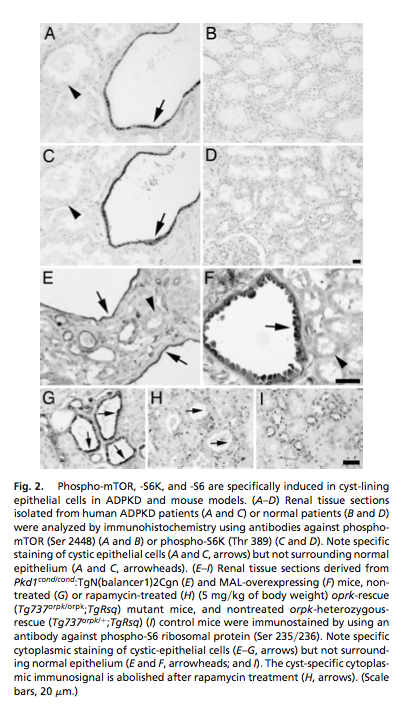
 Polycystic kidney disease cells show abnormal activation of the Ser/Thr kinase target of of rapamycin. This enzyme coordinates cell growth and proliferation. In three animal models of PKD, there is evidence of inappropriate activation of mTOR in the renal cysts. Because of this, blocking mTOR with rapamycin (same thing as sirolimus) is one of the most promising research avenues in ADPKD.
 In this latest study by Perica et al. they had 21 patients and they received either conventional therapy or sirolimus (initial dose: 3 mg daily) for six months and then each patient crossed over to the opposite arm, so every patient received both control and experimental therapy. Six patients dropped out for various reasons and the researchers ultimatly reduced their target sirolimus levels from 10-15 ng/ml to 5-10 ng/ml. The authors explained the adverse reactions in the discussion:
Three patients were prematurely withdrawn from the study because of the onset of an erythema nodosus in one case and thrombocytopenia in two cases after a few days of sirolimus therapy, when sirolimus dosage was titrated to target trough levels between 10 and 15 ng/ml (all events fully resolved with treatment withdrawal). The poor tolerability of this high-dosage regimen led us to reduce the target levels to 5 to 10 ng/ml. With this approach, no serious event requiring treatment interruption was observed.
The primary outcome was change in the kidney volume. The authors, additionally, looked at changes in cyst volume and renal parenchymal volume which was important as they found an increase in the renal parenchyma with stable cyst volume during sirolimus and a reduction in renal parenchyma and increase in cyst volume during usual care.
The primary outcome, a change in renal volume was not significant, P=0.45; however, cyst volume increased more on conventional therapy, P=0.013 and parenchymal volume increased more on sirolimus, P=0.005.

Hypercholesterolemia is another widely known adverse effect of mTOR inhibitors. Our data, however, show that in patients without concomitant medications that may also ad- versely affect the lipid profile, such as steroids or calcineurin inhibitors, hypercholesterolemia is mild and can be easily managed just with dietary counseling. Thus, this adverse effect does not seem to be a major drawback of sirolimus therapy, even in the case of prolonged exposure.

English: A plaque reminding of the discovery of rapamycin (sirolimus) on Rapa Nui (Easter Island), near Rano Kau. The plaque is written in Brazilian Portuguese, and reads: In this location were obtained, in January 1965, soil samples that allowed for the obtainment of rapamycin, a substance that inaugurated a new era for organ transplant patients. An homage from the Brazilian investigators, November 2000.

The St. John Hospital and Medical Center has a nephrology fellowship where I am on the teaching staff. We currently have a particularly talented cohort of fellows but I had no idea how that talented compared on a national scale.
We just got the results of the Nephrology In-Service exam and our crew hit it out of the park. The average score was 69, only 4 programs (with five or more fellows) scored higher. Congratulations guys!

One of the major advancements in nephrology in the first decade of the 21ast century was the rejection of Kt/V as a treatment target in dialysis. In a field that is lacking in randomized clinical trials we had three well done randomized clinical trials designed to verify the mounds of observational data. In all three Kt/V as an expression of dose failed.

Chronic hemodialysis: HEMO


Dialytic support for acute renal failure: VA/NIH ATN trial

What lessons does home hemo have to teach acute renal failure in the ICU? What lessons does it have for peritoneal dialysis. One could argue that one of the central problems in modern dialysis is fluid management. Too many of my patients are chronically fluid overloaded leading to hypertension and over worked hearts. Home hemo corrects hypertension. Is solving that cardiovascular problem accounting for much of the improved clinical outcomes?
Don’t let your patients get volume overloaded
The study is a retrospective interpretation of registry data on children with acute renal failure receiving continuous renal replacement therapy. Each patient was given a fluid overload score by calculating a percentage overload:

They divided patients into three strata:

Worse fluid overload severity remained independently associated with mortality (OR, 1.03; 95% CI, 1.01-1.05). The relationship was satisfactorily linear and the OR suggests a 3% increase in mortality for each 1% increase in degree of fluid overload at CRRT initiation.